THANK YOU FOR SUBSCRIBING
× 
Enterprise Security Mag Weekly Brief
Be first to read the latest tech news, Industry Leader's Insights, and CIO interviews of medium and large enterprises exclusively from Enterprise Security Mag
Enterprise Security Magazine

Gravwell
Rethinking the SIEM for the Realities of Modern Enterprise Data

 Corey Thuen, Founder and CEO
Enterprise security is only as strong as the breadth and integrity of the data it preserves. As cloud use expands, operational technology environments remain critical, and AI adoption introduces new operational layers; telemetry volumes have grown beyond what legacy tools and architectures were designed to handle.
Many traditional security information and event management (SIEM) platforms were built as analytics engines first and databases second—if at all. That design worked when data volumes were manageable; 500 gigabytes used to be considered ‘big data.’ Now, organizations are creating terabytes to petabytes of data every day. Despite leaps and bounds in security technology, legacy SIEMs and log management tools struggle to store such massive quantities of raw telemetry for extended periods while needing to maintain search performance and cost predictability.
Gravwell was built from the outset to address that structural limitation, posing the question, “What would a SIEM look like if built from scratch with the lessons learned over the past decade?” Positioned as a security data platform (SDP) rather than just a SIEM or detection engine, Gravwell is a time-series data lake with SIEM capabilities and analytics built on top, separating the function of storing ground-truth telemetry from the tools that analyze it to enable organizations to economically ingest and store all their data in full fidelity.
At the core of Gravwell’s architecture is a structure-on-query model. Instead of normalizing logs before ingestion, the platform preserves raw records, including binary data, NetFlow, full packet capture and even malformed logs, exactly as received. This model only applies structure at query time, enabling organizations to ingest data types that legacy SIEMs can’t because they parse data on ingest and force it into rigid schemas. This results in dropped data and blind spots across the organization where threats can go undetected.
The distinction becomes especially clear when systems change. For example, if a firewall vendor modifies a log format, schema-on-ingest systems can break, creating ingestion gaps until parsers are updated. With Gravwell’s structure-on-read, data preservation is the priority. Data collection continues, completely uninterrupted.
“One practical advantage is continuity,” says Corey Thuen, founder and CEO. “We continue collecting telemetry even when formats change or records arrive imperfectly. Raw data is power and potential. You might not know which questions you need to ask before you need to ask them.”
Thuen’s background in offensive security shaped this internal discipline, where he cultivated the philosophy of “collect absolutely everything.” He knows how important it is to have all data on hand during an investigation, because you don’t know which questions you need to ask during an incident and which data you’ll need.
“Sometimes it’s a single log entry that tells you how a bad guy got in,” he says.
Gravwell accepts data types that many platforms cannot ingest directly, including binary records and PCAP. That flexibility closes gaps created by tool limitations or format incompatibilities. It preserves what Thuen describes as the “defender’s advantage,” the ability to build organization-specific detections as opposed to relying solely on lowest-common-denominator templates.
The result is investigative continuity without silent data loss. Security teams can revisit historical data, apply new detection logic retroactively and reconstruct events months or years later without discovering that key telemetry was filtered out at ingest.
Scaling Data Without Scaling Cost
How does predictable pricing change security teams’ data collection and investigation behavior?
Scalability without affordability does not solve the enterprise problem. One of the primary reasons organizations limit telemetry collection is economic unpredictability.
Under ingestion-based pricing models, collecting additional logs or running high query volumes during incidents can trigger cost spikes. That creates financial pressure at the exact moment investigative intensity increases.
Gravwell removes that constraint. Customers are not charged per gigabyte of data they ingest or based on the number of searches they execute. In one cloud deployment, a customer runs approximately 60,000 automated searches per day. If that volume increased, the bill would remain the same.
One practical advantage is continuity. We continue collecting telemetry even when formats change or records arrive imperfectly. Raw data is power and potential. You might not know which questions you need to ask before you need to ask them.

The economic impact is measurable. Organizations that switched from legacy platforms report average savings of roughly 40 percent while expanding data collection and retention. Teams that were previously limited to 90 days of searchable logs can now retain a full year of logs. Some maintain up to five years of searchable data without additional cost escalation.
Predictable pricing alters strategic behavior. Security teams investigate aggressively without worrying about overages. They collect broader telemetry sets and support additional departments using the same data service layer.
Mission Support: Structured Transition with No Disruption
Why is migration support critical when replacing legacy SIEM systems in active environments?
Mission Support is not just a built-in service; it's also a core philosophy. It is Gravwell’s dedicated customer success and transition function, which provides white-glove customer service from onboarding to success, and ongoing support that most SIEM vendors do not provide.
During migration from legacy SIEM environments, Mission Support works directly with customers to replicate critical dashboards and detections, preserve investigative workflows and maintain operational continuity. If a SOC depends on a specific dashboard during incident response, that view is rebuilt before cutover.
“Attackers won't slow down to help reduce stress during a switchover,” says Thuen. “That’s exactly why Mission Support matters. Customers need a white-glove experience because they can’t afford disruption, and it's a great opportunity to review and close visibility or detection gaps, which we love doing.”
Supporting Cloud and Isolated Environments Without Compromise
How does unified deployment support both cloud and air-gapped security environments effectively?
Security architecture breaks down when it assumes a uniform infrastructure. Power generation facilities, healthcare systems, and industrial control environments often operate in segmented or air-gapped networks where sending telemetry to a public cloud is not viable. At the same time, other parts of the organization may prefer SaaS deployment for operational simplicity.
Tools designed exclusively for one model force a trade-off. Either sensitive data is moved where it should not be, or visibility is fragmented across environments.
Gravwell’s architecture was built to eliminate that compromise. The same core platform runs in fully isolated deployments, hybrid environments and SaaS configurations without redesign. On-premises installations retain full functionality and search performance. SaaS deployments operate under the same structure-on-read model and pricing discipline.
That consistency has operational impact. Security teams should not maintain parallel tooling for different infrastructure segments. They should not lose visibility in air-gapped environments. They should not accept reduced capability to preserve sovereignty. The architecture allows organizations to operate under their own infrastructure constraints without sacrificing retention depth, search performance or cost predictability. Deployment model becomes a business decision, not a technical limitation.
Auditing AI and Preserving Ground Truth
Gravwell applies the same system-of-record discipline to AI-driven activity.
As organizations deploy automation and agent-driven workflows, the systems they deploy generate actions that must be traceable. Thuen points out that one of the emerging issues with AI is straightforward: “How do you audit what the AI did?”
Gravwell’s structure-on-read architecture ensures that telemetry generated by AI systems is retained in its original form, alongside traditional logs, network traffic and system events. The platform does not rely solely on summarized alerts or derived interpretations. It stores the underlying records and enables advanced correlation.
That design allows teams to reconstruct sequences of activity if something behaves unexpectedly. If an automated workflow modifies a configuration or triggers a downstream event, investigators can query the original data to understand what occurred and in what order.
Because Gravwell’s pricing model does not penalize additional searches or long-term retention, those records remain accessible without cost pressure. AI-driven activity can scale without creating blind spots or financial trade-offs.
In practice, Gravwell extends its system-of-record philosophy to automation. As new machine-generated telemetry appears, it is collected, preserved and made searchable under the same architecture that governs the rest of the environment.
Built for Scale from Inception
Gravwell’s architecture reflects the background of its founding team. With roots in supercomputing, it approached security data as a scale problem first. The platform has served as a system of record for the Supercomputing Conference, where sustained throughput and precision are non-negotiable.
That experience influenced how the database was designed. Instead of modifying a traditional SIEM to handle growing telemetry, Gravwell built its own data layer to support extreme ingestion rates, consistent search performance and predictable economics under load.
Those design decisions now define the platform’s enterprise positioning. As organizations expand hybrid infrastructure and deploy AI-driven systems that generate additional machine activity, Gravwell’s structure-on-read architecture and cost model remain stable. Data is retained without forced normalization. Query performance does not degrade as volumes increase. Pricing does not fluctuate based on search intensity.
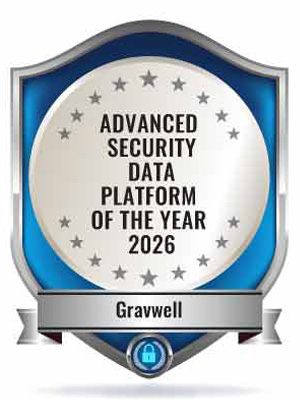
Recognition as the Advanced Security Data Platform of the Year 2026 reflects that engineering foundation. Gravwell’s architecture was designed for scale from inception.
For enterprises evaluating long-term security architecture, that distinction is operational. A system of record must preserve raw telemetry reliably, remain searchable over extended retention periods and function predictably during incident spikes and investigative surges. Gravwell’s architecture is designed to meet those conditions consistently, positioning the platform as infrastructure beneath detection as well as a tool layered on top of it.
Architecting Security Data Platforms for Accountability and Scale
Enterprise security leaders no longer treat log infrastructure as a background utility. Data volumes have expanded beyond what legacy SIEM architectures were designed to handle, while AI agents, regulatory scrutiny and critical infrastructure oversight have raised expectations around traceability. Alerting alone is insufficient. Leadership teams now require a system that preserves raw evidence, scales without penalty and supports forensic, compliance and business analytics use cases from a common foundation.
Traditional SIEM models were built analytics-first, database-second. That design struggles under extreme ingestion rates and evolving telemetry types. Many organizations now separate analytics engines from the environment where data lives, creating a dedicated security data platform that stores raw records at scale and enables flexible interrogation. The strategic question has shifted from which alerts fire to where ground truth resides and how quickly it can be accessed.
Executives evaluating advanced security data platforms must look beyond feature checklists and focus on three underlying capabilities that determine long-term viability. The architecture must sustain very high data volumes without forcing pre-ingest transformation that risks data loss when formats change. Modern environments generate logs, NetFlow, PCAP and binary artifacts that do not conform neatly to predefined schemas. A platform built around structure-on-read preserves raw inputs first and applies interpretation at query time, reducing exposure to ingestion failures and supporting retrospective analysis when new threat intelligence emerges.
Retention economics represent an equally important dimension. Incident response rarely follows predictable volume curves. Spikes in telemetry often coincide with an organization’s worst day. Predictable cost models encourage teams to collect broadly, extend retention and increase analytical intensity without fear of postincident billing shocks. Leaders should examine whether the commercial model supports year-long or multi-year searchable retention rather than forcing compromise at 60 or 90 days.
Flexibility across deployment environments has also become decisive. Critical infrastructure operators, healthcare providers and energy utilities frequently operate air-gapped or hybrid environments where cloudonly tooling is not viable. Data sovereignty concerns and regional compliance regimes, such as GDPR or sectorspecific mandates, require control over where telemetry resides. A viable platform must function in isolated onprem environments and in managed SaaS form without sacrificing capability. This adaptability enables consistent analytics across cloud-native enterprises and organizations managing cyber-physical systems.
AI governance introduces another emerging requirement. Autonomous agents and generative systems create new audit obligations. Security leaders must be able to reconstruct what an agent did, when it acted and which systems were affected. Telemetry from these agents becomes part of the investigative record. Platforms that treat logs as immutable ground truth support accountability and regulatory defensibility in ways that detection-only tools cannot.
Against this backdrop, Gravwell stands out as a compelling option for enterprises modernizing their security data foundation. It was engineered to ingest and retain raw binary, NetFlow and PCAP data without enforced pre-normalization, applying structure at query time to avoid visibility gaps when formats change. Its index-based pricing model removes penalties for ingestion spikes or high search volumes, enabling extended retention and aggressive investigation without unpredictable cost escalation. The platform supports airgapped, on-prem and SaaS deployments while embedding AI capabilities that operate within the customer’s environment to preserve data sovereignty. For CISOs seeking a forwardlooking system of record rather than another alert engine, it represents a disciplined, scalable foundation for enterprise accountability.
...Read more
Company
Gravwell
Management
Corey Thuen, Founder and CEO
Description
Gravwell is a cybersecurity data platform founded in 2017, enabling security teams to ingest unlimited raw logs, PCAP and machine data into a structure-on-read data lake. It powers proactive threat hunting with flexible pipelines, AI-driven Logbot analysis and terabyte-scale queries at 40 percent less compute cost than rivals. Deployable on-prem, cloud or hybrid, its indexer pricing supports enterprise SOCs without data penalties.